“Say please.”
“Say thank you.”
“Don’t interrupt.”
“Be nice to your sister.”
Most children hear reminders like these hundreds of times while growing up.
Good manners are important. But respect goes much deeper than manners.
Respect means recognizing that other people matter.
It influences how children speak, listen, disagree, share, respond to authority, treat possessions, behave toward older people, interact with younger children, and eventually conduct themselves in the larger world.
For homeschool families, respect doesn’t have to become another chapter in a textbook.
It can be taught where children experience it every day:
At home.
Children Learn Respect by Watching It
Children pay attention to far more than adults sometimes realize.
They notice how parents speak to each other.
They notice how adults treat a restaurant server.
They hear conversations about neighbors.
They watch how parents respond when frustrated.
They notice whether adults interrupt each other.
They hear how family members speak about people with whom they disagree.
In other words, children don’t learn respect only from what adults tell them.
They also learn from what adults show them.
That can be a powerful reminder for homeschool parents.
Everyday family interactions are part of a child’s education.
Respect Doesn’t Mean Agreement
One of the most important lessons children can learn is that respecting someone doesn’t mean agreeing with everything that person says.
Two people can have different opinions and still treat one another with dignity.
A parent might ask:
“Can you disagree with someone without being mean to them?”
Then follow with:
“How?”
Perhaps the child answers:
“Don’t yell.”
“Let them talk.”
“Don’t call them names.”
“Explain why you disagree.”
Those simple answers introduce skills children will need throughout life.
As children grow older, they will encounter many people whose ideas differ from their own.
Learning how to disagree respectfully is part of preparing them for adulthood.
Listening Shows Respect
Sometimes respect is demonstrated by something as simple as listening.
Imagine a child telling a story while another family member repeatedly interrupts.
Eventually the child may become frustrated.
That’s an opportunity for a question:
“How does it feel when someone doesn’t let you finish speaking?”
Now reverse the situation.
“How do you think someone else feels when you interrupt them?”
Suddenly, a rule such as “don’t interrupt” has a reason behind it.
Children begin understanding not only what the family expects, but why.
Respect Begins With the People Closest to Us
It is sometimes easier to be polite to strangers than to family.
Children may say “please” to a neighbor while shouting at a sibling five minutes later.
That’s normal childhood behavior—but also an opportunity to teach.
Brothers and sisters can become a child’s first classroom for relationships.
They learn to:
-
Share.
-
Take turns.
-
Resolve disagreements.
-
Respect another person’s belongings.
-
Apologize.
-
Forgive.
-
Help.
-
Compromise.
-
Live with someone whose personality may be very different from their own.
These are not small lessons.
They are practice for future friendships, workplaces, marriages, neighborhoods, and communities.
Respect Includes Property
Respect isn’t limited to people.
Children can also learn respect by taking care of things.
Returning borrowed items.
Putting toys away.
Handling books carefully.
Taking care of family belongings.
Cleaning up after themselves.
Treating another person’s possessions appropriately.
Why does that matter?
Because respecting property teaches children that their actions can affect other people.
A child who damages something belonging to a sibling isn’t simply breaking an object.
They may be damaging something another person values.
That realization builds responsibility.
Respect for Older Generations
Parents and grandparents can offer children something technology cannot:
Experience.
They have lived through successes, disappointments, mistakes, changes, celebrations, hardships, and decisions that children have yet to encounter.
Children don’t have to agree with every opinion an older person holds.
But they can learn to listen.
A homeschool parent might ask:
“What is something Grandma or Grandpa knows that you would like to learn?”
Perhaps it is gardening.
Cooking.
Fishing.
Fixing something.
Family history.
A childhood story.
A tradition.
Or simply what life was like when they were young.
Questions like these can strengthen connections between generations while teaching children that wisdom and experience have value.
Respect Also Means Respecting Yourself
There is another side to respect that children need to understand.
Being respectful doesn’t mean allowing other people to treat you badly.
Children can learn that they deserve appropriate respect too.
They can say:
“Please don’t talk to me that way.”
“I don’t like that.”
“Please stop.”
They can ask an adult for help when necessary.
They can learn that kindness and boundaries can exist together.
Respect should work in both directions.
JeanieOlogy™ Can Start the Conversation
Many lessons about respect begin naturally with questions.
That’s where JeanieOlogy™ can become useful for homeschool families.
Imagine asking:
“What does respect look like?”
“Should you respect someone even when you disagree with them?”
“Why is it important to listen when someone else is talking?”
“How should you treat something you borrowed?”
“What should you do if you accidentally hurt someone’s feelings?”
“Can you be respectful and still say no?”
The purpose isn’t simply to get the “correct” answer.
The purpose is to hear how the child thinks.
Then parents can explain the values and expectations that guide their own family.
Turn Everyday Situations Into Questions
JeanieOlogy™ doesn’t have to end when the cards are put away.
Parents can use the same question-based approach throughout the homeschool day.
A sibling interrupts.
“How could you handle that respectfully?”
Someone leaves a mess.
“Who will have to clean that up if you don’t?”
A child speaks rudely.
“Could you say the same thing differently?”
Someone helps.
“How could we show appreciation?”
A disagreement occurs.
“What would a respectful solution look like?”
Questions encourage children to think about their behavior rather than merely respond to commands.
Respect Shouldn’t Depend on Who Is Watching
Children often behave differently when adults aren’t nearby.
That’s where character becomes important.
The goal isn’t simply:
“Behave because Mom is watching.”
The larger goal is:
“Treat people properly because it is the right thing to do.”
That transition takes time.
It develops through expectations, examples, consequences, encouragement, and repeated conversations.
Homeschool parents have many opportunities to reinforce these lessons because family life and education happen together.
Manners Are the Beginning, Not the End
Please.
Thank you.
Excuse me.
You’re welcome.
I’m sorry.
These simple words matter.
But behind those words should gradually develop something deeper.
Consideration.
Patience.
Fairness.
Listening.
Self-control.
Kindness.
Responsibility.
An awareness that other people have feelings, needs, ideas, possessions, and experiences worthy of consideration.
That is respect.
Yesterday’s Values Still Matter Tomorrow
The world children enter as adults will undoubtedly look different from the world their parents knew.
Technology will change.
Jobs will change.
Communication will change.
Education will change.
But some qualities will remain valuable.
Knowing how to listen.
Knowing how to disagree without cruelty.
Knowing how to treat people properly.
Knowing how to apologize.
Knowing how to show appreciation.
Knowing that another person’s dignity matters.
JeanieOlogy™ gives homeschool families a simple and enjoyable way to bring those conversations into everyday life.
One card may produce a laugh.
The next may produce a question.
And that question may begin a conversation a child remembers long after the homeschool lesson is finished.
Because respect isn’t simply something children should learn about.
It’s something they learn to live.
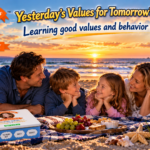
JeanieOlogy™ — Yesterday’s Values for Tomorrow’s Children.
© Copyright Aunt Jean’s Kids, LLC. All Rights Reserved.