
Every parent and grandparent hopes to pass something meaningful to the next generation.
We may leave children photographs, family traditions, treasured possessions, or stories about relatives they never had the opportunity to meet. But perhaps one of the most important things we can pass along cannot be placed in a box or displayed on a shelf.
Our values.
Honesty. Kindness. Respect. Responsibility. Gratitude. Patience. Generosity. Faithfulness. Perseverance. Compassion.
Most parents and grandparents know these qualities matter. The harder question is:
How do we make those values come alive for a child?
Simply telling children to “be kind,” “tell the truth,” or “show respect” is important—but children also need opportunities to think about what those ideas actually mean.
JeanieOlogy™ was created to help make those conversations easier, more natural, and more enjoyable.
Values Are Learned Through Everyday Life
Some of the most important lessons children learn never appear on a report card.
Consider how many teachable moments happen during an ordinary week.
A brother refuses to share.
A friend says something hurtful.
Someone makes a mistake and doesn’t want to admit it.
A child receives money for a birthday and must decide whether to spend or save it.
Someone at school is being left out.
Each situation presents an opportunity to talk about values.
But families don’t have to wait for a problem before having those conversations.
We can talk about values before children need to make the difficult choice.
That is where JeanieOlogy™ can become a useful family resource.
Begin With Something Children Already Love—Fun
Children rarely wake up thinking, I hope someone teaches me about character today.
But most children are happy to laugh, imagine, tell stories, and be silly with Mom, Dad, Grandma, or Grandpa.
That’s why every JeanieOlogy™ card combines two experiences.
First comes the Giggle Moment—a playful question or activity designed to encourage imagination and laughter.
Then comes Aunt Jean’s Question—a thoughtful question that opens the door to conversation.
The transition is intentional.
Instead of announcing, “We’re going to have a serious discussion about values,” families simply start having fun.
And somewhere between the laughter and conversation, learning begins.
Don’t Just Tell Children What You Believe—Ask What They Think
There is an important difference between telling children the answer and helping them discover an answer.
Imagine asking:
“Why is it important to share with others?”
One child might talk about fairness.
Another might say sharing makes someone happy.
Another may remember a time when somebody shared with them.
And another child may simply say, “Because it’s nice.”
Each response gives the adult an opportunity to ask another question:
“Why?”
That little word can produce some remarkable conversations.
When children explain their reasoning, parents and grandparents gain insight into how they see the world.
JeanieOlogy™ encourages children to participate rather than simply listen.
Grandparents Can Bring Values to Life Through Stories
Grandparents have a wonderful advantage when talking about values.
They have a lifetime of stories.
A question about responsibility may remind Grandpa of his first job.
A conversation about saving money might remind Grandma of how carefully her family budgeted when she was young.
A discussion about honesty may bring back a childhood mistake—and the lesson learned from it.
These aren’t abstract lessons anymore.
They are real stories involving real people the child loves.
And children often remember stories far longer than instructions.
Grandparents aren’t simply teaching a value.
They are connecting that value to the family’s history.
Parents Can Connect the Conversation to Everyday Choices
Parents have another powerful opportunity.
They can take a JeanieOlogy™ conversation and connect it to something happening in the child’s life right now.
Suppose a card leads to a discussion about kindness.
Later that week, a parent might say:
“Remember what we talked about when we played JeanieOlogy™? What could we do here?”
Suddenly the earlier conversation has moved into real life.
That is when values begin becoming behavior.
The goal isn’t merely for children to know the definition of kindness, responsibility, gratitude, or respect.
The goal is to help them recognize opportunities to practice those values themselves.
Make JeanieOlogy™ Fit Your Family
There is no single “correct” way to use JeanieOlogy™.
One family might play after dinner.
Grandparents might bring it out when grandchildren visit.
Another family might use one card on Sunday afternoon.
You can also expand a conversation when a subject becomes particularly interesting.
Ask another question.
Tell a family story.
Let the child ask the adults what they think.
Skip a question when appropriate.
Or create a new question inspired by something happening in your own family.
The game should serve the conversation—not control it.
Listen for the Unexpected Answers
One of the most interesting parts of talking with children is discovering what they actually think.
Sometimes their answers are funny.
Sometimes surprisingly thoughtful.
Sometimes completely unexpected.
And occasionally their answers reveal something an adult didn’t realize the child was thinking about.
Those are valuable moments.
Rather than immediately correcting an answer, try asking:
“What makes you think that?”
A conversation that lasts five minutes may reveal more about a child’s developing character than adults expected.
Values Become Stronger When Children See Them Lived
Of course, conversations alone aren’t enough.
Children watch us.
They notice how Dad treats a waiter.
They notice whether Mom keeps a promise.
They notice whether Grandma shows gratitude.
They notice whether Grandpa admits when he is wrong.
Our actions give credibility to our words.
JeanieOlogy™ helps families talk about values, but everyday life gives adults the opportunity to demonstrate them.
Together, those experiences can be powerful.
Your Values. Their Future.
The original Homeschool version emphasized that character, judgment, communication, and family values are important preparation for life—not merely academic achievement.
The same principle applies to every parent and grandparent.
Children will eventually grow up and make thousands of decisions without us standing beside them.
We cannot make every choice for them.
But we can help give them something to carry into those moments:
A foundation.
A memory.
A family story.
A question that made them think.
A value they watched someone they loved demonstrate.
JeanieOlogy™ provides a simple way to begin.
Because sometimes teaching a child something that lasts a lifetime begins with something surprisingly small—
One card. One laugh. One conversation at a time.
© Copyright Aunt Jean’s Kids, LLC. All Rights Reserved.

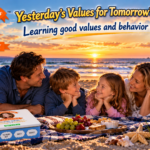 One of the greatest benefits of homeschooling is the freedom to teach not only academic subjects but also the values and character traits that help children become caring, responsible adults. While textbooks teach facts, many of life’s most important lessons are learned through meaningful conversations. JeanieOlogy™ was created to make those conversations enjoyable. Designed for… Read more: Week 2-HS-Article- Making Values Come Alive in Your Homeschool