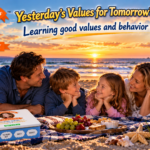
What was your child’s most important lesson today?
Was it a math problem?
A new vocabulary word?
A science experiment?
A chapter in history?
Maybe.
But perhaps the most important lesson happened somewhere else.
Maybe your child returned money a cashier accidentally gave them.
Helped a younger sibling without being asked.
Admitted breaking something.
Waited patiently when plans changed.
Comforted a friend.
Shared something they wanted to keep.
Or apologized after saying something hurtful.
None of those lessons may appear on tomorrow’s test.
Yet they may help determine the kind of adult that child eventually becomes.
For homeschool families, this presents an extraordinary opportunity.
The classroom doesn’t have to end at the desk.
Education Is Bigger Than Academics
Reading, writing, mathematics, science, history, and other academic subjects are essential parts of a child’s education.
But parents are preparing children for something larger than academic achievement.
They are preparing them for life.
Someday children will manage money.
Work with people they don’t always like.
Make promises.
Experience disappointment.
Face temptation.
Help people.
Make mistakes.
Choose friends.
Accept responsibilities.
Encounter people who disagree with them.
And make decisions when no parent or teacher is there to provide the answer.
That means education should involve more than asking:
“What does my child know?”
We should also occasionally ask:
“What kind of person is my child learning to become?”
Everyday Life Is Filled With Lessons
Homeschool families don’t have to create elaborate character-development programs to teach values.
Life provides the curriculum.
Imagine going grocery shopping with your child.
You can discuss:
Money.
Why does one product cost more than another?
Choices.
Do we need this or simply want it?
Planning.
Why did we make a shopping list?
Patience.
Why can’t we buy everything we want today?
Kindness.
Should we allow the person with one item to go ahead of us?
Honesty.
What should we do if the cashier gives us too much change?
One trip to the grocery store can provide lessons in mathematics, economics, responsibility, manners, decision-making, and character.
That’s education beyond the textbook.
Chores Can Teach More Than Cleanliness
Most children don’t wake up excited about household chores.
That may be exactly why chores can be useful.
Making a bed, feeding a pet, emptying the dishwasher, helping with laundry, or taking out the trash can teach:
-
Responsibility
-
Reliability
-
Cooperation
-
Self-discipline
-
Respect for shared spaces
-
Appreciation for other people’s work
A child gradually learns:
“I am part of this family, and other people depend upon me.”
That’s a powerful lesson.
Nature Can Become a Classroom
Homeschool families also have the flexibility to take learning outdoors.
A walk through the woods can become a science lesson.
A visit to the beach can introduce discussions about tides, wildlife, conservation, weather, or geography.
A garden can teach biology, patience, responsibility, and the satisfaction of watching something grow.
But nature can also encourage something harder to measure:
Wonder.
Children can learn to notice beauty.
To appreciate quiet.
To respect living things.
To recognize that not every meaningful experience requires a screen, a purchase, or entertainment.
Sometimes an important lesson begins simply by stopping and looking around.
Difficult Moments Can Become Lessons Too
Not every learning opportunity is pleasant.
Plans get canceled.
Toys break.
Children lose games.
Friends disappoint them.
Schoolwork becomes frustrating.
Someone behaves unfairly.
A child makes a mistake.
Parents naturally want to protect children from disappointment, but some difficult experiences provide opportunities to develop resilience.
Instead of immediately solving every problem, a parent might ask:
“What do you think you should do?”
Or:
“What could you do differently next time?”
Or:
“What part of this situation can you control?”
These questions help children learn how to think through problems.
JeanieOlogy™ Can Help Connect Life and Learning
This is where JeanieOlogy™ can fit naturally into a homeschool environment.
The game doesn’t require parents to create another formal class.
Instead, its questions can help families talk about situations children may already be experiencing.
A JeanieOlogy™ conversation might begin with:
“Why is it important to keep a promise?”
That could lead to a discussion about something that happened earlier in the week.
Another question might ask children to think about sharing, honesty, kindness, responsibility, gratitude, or friendship.
The important part isn’t simply answering the card.
It’s what happens after the answer.
Follow the Conversation
Suppose a child gives an unexpected response.
Don’t rush to the next question.
Ask:
“Why do you think that?”
Those five words can sometimes produce the most interesting part of the conversation.
A child may reveal something that happened with a friend.
A worry.
An assumption.
Something they misunderstood.
An idea they have never expressed before.
Now the parent has an opportunity to listen—and guide.
That is one of the reasons conversation can be such a powerful learning tool.
Create Your Own Questions
JeanieOlogy™ was designed to be flexible.
Parents can skip questions that don’t fit the moment, modify them, or create new ones based upon something their children are studying or experiencing.
Studying American history?
Ask:
“What qualities do you think make someone a good leader?”
Studying animals?
Ask:
“Why should people take care of animals?”
Learning about money?
Ask:
“Would you rather spend your money today or save for something important later?”
Studying a historical conflict?
Ask:
“What could the people involved have done differently?”
Suddenly character education and academic education aren’t separate subjects.
They begin working together.
Family Stories Are Educational Too
Some of the best lessons children receive may come from stories that never appear in a textbook.
Tell them about Grandpa’s first job.
Grandma’s childhood.
A mistake you made when you were young.
Someone in the family who demonstrated courage.
A time when money was tight.
A relative who helped someone.
A family tradition and why it matters.
Stories connect values with real people.
Children discover that concepts such as perseverance, generosity, honesty, and responsibility aren’t just words.
They are qualities people actually live.
Fun Has a Place in Learning
Character education doesn’t need to feel heavy.
Children learn through laughter too.
JeanieOlogy™ combines thought-provoking Aunt Jean’s Questions with playful Giggle Moments, creating opportunities for families to move naturally between fun and meaningful conversation.
One moment everyone may be laughing.
The next moment a child may say something surprisingly thoughtful.
That balance can help values conversations feel like family time rather than another lesson being assigned.
The Lessons Children Remember
Years from now, your child may not remember every worksheet.
They may forget many test questions.
They may not remember every chapter of every textbook.
But they may remember something else.
The afternoon you stopped what you were doing and listened.
The story Grandpa told.
The time they admitted a mistake and you helped them make it right.
The family discussion around the kitchen table.
The question that made everyone laugh.
The question that made everyone think.
Those experiences become part of a child’s education too.
Homeschooling Gives Families Something Special
One of the great strengths of homeschooling is the ability to connect learning with living.
Math can happen at the grocery store.
Science can happen beside a stream.
History can lead to conversations about courage.
Chores can teach responsibility.
Mistakes can teach resilience.
Family stories can teach values.
And a simple card game can begin conversations about the kind of person a child wants to become.
JeanieOlogy™ can help homeschool families make those conversations easier to begin.
Because some of life’s most important lessons aren’t found on a worksheet.
They’re found in everyday moments—and in the conversations we choose to have about them.
JeanieOlogy™ — Yesterday’s Values for Tomorrow’s Children.
© Copyright Aunt Jean’s Kids, LLC. All Rights Reserved.