Reading a favorite holiday story.
Fishing with Grandpa.
Cooking Grandma’s recipe.
Walking on the beach together.
Volunteering during the holidays.
Playing games around the kitchen table.
Traditions create continuity.
They tell children:
“This is something our family does.”
And underneath that message is something even more important:
“You are part of this family.”
That sense of belonging can become an important part of a child’s identity.
Values Are Passed Along Through Behavior
Parents can tell children kindness matters.
But children learn something even stronger when they see kindness practiced.
They can hear that generosity matters.
But watching a parent quietly help someone makes the lesson real.
They can be told to respect older people.
But watching Mom or Dad patiently listen to an elderly relative demonstrates what respect looks like.
Children notice.
Often the strongest lessons aren’t taught deliberately at all.
They’re observed.
That makes one question particularly important for parents:
“What are my children learning from the way I live?”
JeanieOlogy™ Was Built Around This Idea
At its heart, JeanieOlogy™ isn’t simply about answering questions.
It’s about creating conversations between generations.
The Giggle Moments can create laughter.
The Aunt Jean’s Questions can create reflection.
And sometimes a simple question can unlock a family story.
Imagine asking:
“What is something your grandparents taught you?”
A parent answers first.
That answer leads to a story.
The child asks another question.
Someone remembers something else.
Before long, the card is almost forgotten because the conversation has taken on a life of its own.
That isn’t a distraction from the game.
That is part of its purpose.
Let Children Know Where Your Values Came From
Children may know what their parents believe without knowing why.
Tell them.
Perhaps honesty was important because your father insisted that a person’s word mattered.
Maybe generosity came from watching your mother help people even when she didn’t have much herself.
Perhaps your respect for money developed because your family had to be careful with every dollar.
Maybe your love of nature began with childhood trips to the mountains, woods, lake, or beach.
These stories help children understand that values aren’t simply rules adults invented for them.
They often have histories.
Create New Family Stories
A legacy doesn’t consist only of the past.
Families are creating tomorrow’s stories right now.
The family camping trip that seems ordinary today may become something your child describes to their own children someday.
The game played around the kitchen table may become:
“We used to play this when I was little.”
The question that produces laughter today may become a story repeated at Thanksgiving twenty years from now.
The conversations happening during childhood can become part of the family’s history.
That is worth remembering.
Homeschooling Offers Time for Connection
One of the great opportunities of homeschooling is time together.
Certainly there are assignments to complete.
Lessons to teach.
Schedules to manage.
Activities to attend.
And days when nothing goes according to plan.
But woven throughout those days are opportunities for something deeper.
Conversation.
Stories.
Questions.
Shared experiences.
Family traditions.
Those moments aren’t interruptions to education.
In many ways, they are education.
Ask Your Children the Questions That Matter
Homeschool parents spend a great deal of time asking questions.
“What is seven times eight?”
“What year did that happen?”
“How do you spell that word?”
“What is the capital of Colorado?”
Those questions matter.
But occasionally ask different ones.
“What do you think makes someone a good person?”
“What is something our family does that you hope you’ll do with your children someday?”
“Who in our family do you admire?”
“What is something you’ve learned from Grandma or Grandpa?”
“What do you think our family believes is important?”
The answers might be funny.
They might be surprising.
And sometimes they may tell parents whether the values they hope to pass along are actually being heard.
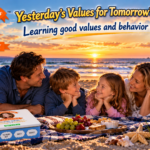
Yesterday’s Values for Tomorrow’s Children
There is a reason those words are so closely connected with JeanieOlogy™.
Every generation receives something from the one before it.
Then it decides what to carry forward.
Someday today’s children may become parents and grandparents themselves.
They may sit at a kitchen table with children of their own.
They may repeat one of your sayings.
Tell one of your stories.
Prepare one of your recipes.
Continue one of your traditions.
Or explain a lesson you once taught them.
And perhaps they will remember the conversations you had when they were young.
That’s how values travel through generations.
Not simply through instructions.
But through stories, examples, laughter, questions, traditions, and time spent together.
JeanieOlogy™ was created to help families make room for those moments.
Because the greatest thing we leave our children may not be something they can hold in their hands.
It may be something they carry within themselves.
JeanieOlogy™ — Yesterday’s Values for Tomorrow’s Children.
© Copyright Aunt Jean’s Kids, LLC. All Rights Reserved.