
“Every child is learning values every day.
The question isn’t whether they’re learning—but who is doing the teaching.”
By Dr. Gil, Creator of JeanieOlogy™
Every parent and grandparent hopes the children they love will grow into adults who are honest, kind, responsible, respectful, compassionate, confident, and capable of making wise decisions.
But consider a question we may not ask often enough:
Where are our children learning those values today?
The first answer is usually obvious.
From us.
And parents and grandparents certainly have an extraordinary influence.
But they aren’t the only teachers.
Today’s children are surrounded by voices competing for their attention. Some are obvious. Others quietly become part of a child’s thinking without anyone realizing it.
That’s why intentionally talking about family values may be more important today than ever.
Children Are Learning All the Time
Children are remarkable observers.
They notice how Dad reacts when another driver cuts him off.
They notice how Mom talks about someone when that person isn’t present.
They notice whether Grandma is patient with a store clerk.
They notice whether Grandpa keeps his promises.
They notice how adults respond when they’re disappointed, frustrated, embarrassed, or wrong.
Long before children can explain their personal values, they are already learning from the behavior around them.
Every relationship teaches something.
Every experience communicates something.
Every conversation can leave an impression.
Values aren’t formed during one grand family discussion.
They’re developed little by little through everyday life.
But Family Isn’t the Only Teacher
Think about how many different voices a child may encounter.
Parents and grandparents.
Brothers and sisters.
Teachers and coaches.
Friends and classmates.
Neighbors and relatives.
Books.
Music.
Movies and television.
Video games.
Advertising.
Online videos.
Social media.
Influencers and online personalities.
Each may communicate messages about what is funny, attractive, important, successful, acceptable, or desirable.
Many of those messages can be perfectly positive.
Others may conflict with what your family believes.
The solution isn’t to make children frightened of the world around them.
The solution is to prepare them for it.
Give Children a Foundation Before They Need It
Imagine your child or grandchild hears a friend say something unkind about another child.
What happens next?
A child with no framework for thinking about the situation may simply follow the group.
But a child who has repeatedly discussed kindness, courage, friendship, and respect has something to draw upon.
They have a foundation.
They may remember Mom asking:
“How do you think that would make the other person feel?”
They may remember Grandpa telling a story about standing up for someone.
They may remember Grandma saying:
“Being kind sometimes means doing something different from everyone else.”
Those conversations don’t guarantee what a child will do.
But they give the child something important to think about when the moment arrives.
Don’t Just Give Children Rules—Help Them Develop Judgment
Rules are necessary.
But eventually children will encounter situations for which Mom, Dad, Grandma, and Grandpa haven’t provided a rule.
That’s when judgment becomes important.
Why does honesty matter?
Why should we show respect to someone we disagree with?
Why is gratitude important?
Why should we forgive?
Why should we help someone who can’t help us in return?
When children discuss questions like these, they begin moving beyond memorizing rules.
They begin learning how to think about choices.
Grandparents Have a Voice Children May Remember Forever
Grandparents occupy a special place in many children’s lives.
They can say:
“Let me tell you what happened to me when I was your age.”
Suddenly the conversation changes.
A discussion about courage becomes Grandpa’s story.
A conversation about generosity becomes something Grandma remembers her mother doing.
A lesson about responsibility becomes a story about a first job.
Grandparents have decades of experiences that can turn abstract values into memorable family stories.
And those stories accomplish something else.
They connect generations.
Children begin understanding that their family’s values didn’t begin with them.
They are part of something larger.
Parents Bring Those Values Into Everyday Life
Parents have another powerful opportunity: repetition.
They see children making decisions every day.
Suppose your family has talked about gratitude.
The next time someone does something thoughtful for your child, you have an opportunity:
“How could we show that person we appreciate what they did?”
A discussion about responsibility can become:
“What do you think your responsibility is in this situation?”
A conversation about honesty can become:
“What would telling the truth look like here?”
Now the value isn’t merely something discussed during family time.
It becomes part of real life.
JeanieOlogy™ Helps Get the Conversation Started
Sometimes parents and grandparents know they want to discuss values but aren’t sure how to begin.
A serious announcement—
“Tonight we’re going to discuss character.”
—probably isn’t going to produce tremendous excitement from a seven-year-old.
JeanieOlogy™ approaches the conversation differently.
Each card begins with a Giggle Moment designed to encourage imagination, participation, silliness, and laughter.
Then comes Aunt Jean’s Question, gently opening a conversation about choices, relationships, behavior, and values.
Children aren’t simply listening to adults talk.
They’re participating.
They get to explain what they think.
And adults get an opportunity to listen.
Your Family Determines What the Conversation Means
No two families are identical.
Each has its own traditions, experiences, priorities, beliefs, and expectations.
JeanieOlogy™ isn’t intended to replace those differences.
It gives families a starting point for discussing them.
Parents and grandparents can explain what honesty, gratitude, respect, responsibility, generosity, courage, and compassion mean in their own family.
And when appropriate, families can skip a question, modify it, expand it, or create a new one that better reflects something currently happening in the child’s life—flexibility specifically encouraged in the original material.
Make Your Family’s Voice Familiar
Parents and grandparents cannot control every message children will encounter.
Nor should that be the goal.
Our children eventually need to navigate the world independently.
What we can do is make certain they recognize one voice very clearly:
the voice of their family.
A voice that has repeatedly talked about honesty.
Kindness.
Respect.
Responsibility.
Gratitude.
Compassion.
Courage.
Generosity.
And love.
Someday, our children and grandchildren will make important decisions when we aren’t standing beside them.
But perhaps something we’ve taught them will be.
A story.
A conversation.
A family value.
A memory of someone they loved saying:
“What do you think is the right thing to do—and why?”
The world will always have plenty to say to our children.
Let’s make sure our family’s voice is one they know by heart.
© Copyright Aunt Jean’s Kids, LLC. All Rights Reserved.
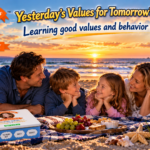 One of the greatest benefits of homeschooling is the freedom to teach not only academic subjects but also the values and character traits that help children become caring, responsible adults. While textbooks teach facts, many of life’s most important lessons are learned through meaningful conversations. JeanieOlogy™ was created to make those conversations enjoyable. Designed for… Read more: Week 2-HS-Article- Making Values Come Alive in Your Homeschool